


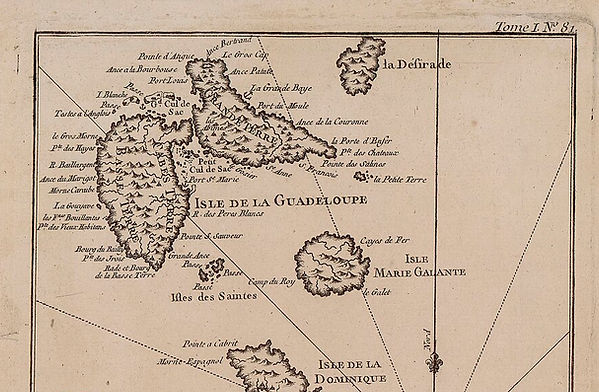
_-_btv1b8596319s.jpg)
Guadeloupe and Martinique during the French Revolution: two sister islands, two contrasting fates
Between 1789 and 1802, Guadeloupe and Martinique, though so close, experienced the French Revolution in radically different ways. One experienced freedom, the guillotine and heroic sacrifice; the other endured this period under the British flag, without ever seeing slavery abolished. A look back at a decade that still explains many of the differences between the two islands today.
1794: the Convention abolishes slavery
On 4 February 1794 (16 Pluviôse, Year II), the National Convention in Paris voted to abolish slavery in all French colonies. This was the first abolition in French history. But between the decree and its implementation in the West Indies, everything would depend on who controlled each island.
Martinique: the planters side with England
In Martinique, the major royalist planters rejected the Revolution and, above all, the impending abolition. On 19 February 1794, representatives of the planters from Martinique, Guadeloupe and Saint-Domingue signed the Whitehall Agreement in London: they invited Great Britain to occupy their islands in exchange for the preservation of slavery and their property rights.
As early as 6 February 1794, Admiral John Jervis’s British troops landed in Martinique, aided by the planters, and faced General Rochambeau’s Republican garrison, which surrendered in March. The island became a British-administered possession, with the planters in control.
A major consequence was that the abolition decree of February 1794 was never enforced in Martinique. Neither the Revolution, nor the Reign of Terror, nor the guillotine succeeded in bringing it about. Slavery continued uninterrupted there. The occupation lasted until the Treaty of Amiens on 25 March 1802, under which Britain returned the island to France.

Source: BNF – Gallica – https://gallica.bnf.fr/conseils/content/labolition-de-lesclavage-1794
Guadeloupe: Victor Hugues, freedom and the Reign of Terror
Guadeloupe, too, was occupied by the British in April 1794. But the Convention sent Commissioner Victor Hugues, who landed in June 1794 with around 1,150 men, a decree of abolition… and a guillotine.
Hugues immediately proclaimed the abolition of slavery. Thousands of newly freed people joined the Republican ranks, and the British were driven from the island in October 1794. This was followed by a violent crackdown on the royalist colonists who had collaborated with Britain: a Revolutionary Tribunal sentenced several hundred people to death, who were either guillotined or shot. Historians cite figures in the region of several hundred executions (around 300 émigrés shot in a single incident; around 500 people who had fought alongside the British were executed, according to other sources), whilst many other colonists had fled the island. Hugues came to be known as the ‘Robespierre of the colonies ’.
For eight years, Guadeloupe thus lived without slavery, even though Hugues imposed compulsory labour on the ‘new citizens’ in the plantations – a form of freedom that was strictly regulated.
1801–1802: the crisis, Richepance and the sacrifice of Delgrès
In 1801, Rear Admiral Lacrosse, appointed Captain-General by Bonaparte (then First Consul — the Directory had been overthrown in late 1799), stepped up his harassment of officers of colour. On 21 October 1801, the garrison at Pointe-à-Pitre rose up; Lacrosse was arrested and then expelled from the island in early November. A provisional council led by Brigade Commander Magloire Pélage administered the colony, whilst proclaiming its loyalty to France.
Bonaparte regarded this as a rebellion. On 6 May 1802, General Antoine Richepance landed in Guadeloupe at the head of an expeditionary force of over 3,500 men. When he set about disarming and humiliating the soldiers of colour, a group of them, led by Colonel Louis Delgrès, joined the resistance. On 10 May 1802, Delgrès signed his famous proclamation, ‘To the whole world, the last cry of innocence and despair’, under the motto "Live free or die".
Following fierce fighting in Basse-Terre and the death of Joseph Ignace and his men at Baimbridge on 25–26 May, Delgrès took up a defensive position on the heights of Matouba, in Saint-Claude. On 28 May 1802, surrounded at the Danglemont plantation, Delgrès and around 300 of his companions blew themselves up with their barrels of gunpowder rather than surrender. Richepance died of yellow fever a few months later, on 3 September 1802, and Lacrosse, having returned, carried out a ferocious crackdown.
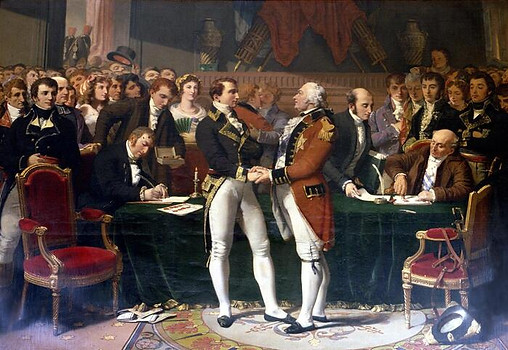
"The Peace of Amiens", oil on canvas by Jules-Claude Ziegler (1853), Musée de Picardie, Amiens. Joseph Bonaparte shakes hands with Lord Cornwallis during the signing of the treaty on 25 March 1802.
The Peace of Amiens: Britain returns its colonies to France
Whilst Guadeloupe was engulfed in flames, diplomacy was redrawing the map of the West Indies. On 25 March 1802 (4 Germinal, Year X), after ten years of war, France and Great Britain signed the peace treaty at Amiens: Joseph Bonaparte, elder brother of the First Consul, represented France; Lord Cornwallis represented Great Britain, alongside Spain and the Batavian Republic.
Article III of the treaty proved decisive for our history: Britain returned to France the colonies it had occupied during the war – Martinique, Tobago and Saint Lucia – but retained Trinidad (taken from Spain) and Ceylon. Martinique thus became French once more after eight years of British occupation, with its system of slavery intact. It was precisely to organise the administration of these returned colonies that the Act of 20 May 1802 was passed two months later. The peace was to be short-lived: as early as May 1803, war broke out again between the two powers.
The re-establishment of slavery: two texts for two situations
It is here that the fates of the two islands tragically converge, through two distinct texts:
The Act of 20 May 1802 maintained slavery in the colonies returned under the Treaty of Amiens, where the 1794 abolition had never been implemented: Martinique, Tobago and Saint Lucia. In Martinique, therefore, there was legally no ‘reinstatement’: slavery had never ceased there.
In Guadeloupe, where abolition had been in force since 1794, slavery was reimposed by Richepance’s military force as early as the summer of 1802, and then formalised by a Consular Decree of 16 July 1802, long overlooked by historians; the original was not discovered in the National Archives until 2007. Guadeloupe is thus the only territory in the world where free men and women were officially returned to slavery.
The consular decree of 16 July 1802: a text signed by Bonaparte… and kept secret
The document is strikingly austere. Dated "Paris, 27 Messidor, Year 10 of the One and Indivisible Republic" (16 July 1802), it consists of two articles, handwritten on a ministry "Draft Decree" form, and signed "The First Consul, Bonaparte". Article 1 stipulates that "the colony of Guadeloupe and its dependencies shall be governed, in the same way as Martinique, Saint Lucia, Tobago and the Eastern Colonies, by the same laws that were in force there in 1789". Article 2 entrusts its implementation to the Minister for the Navy and the Colonies.
The word "slavery" does not appear even once. Yet a return to the ‘laws in force in 1789’ meant reinstating the Code Noir and the entire slave-based order of the Ancien Régime. Another peculiarity: a marginal note specifies that the copy was sent the following day "to the Minister for the Navy (and to him alone)". The decree was never published in the Bulletin des lois, a highly unusual occurrence for a text of this significance. This near-secrecy explains why historians have long searched for it in vain: several Guadeloupean historians had assumed its existence, but the original was not discovered in the National Archives until late 2007, and an analysis of it was published by the legal scholars Jean-François Niort and Jérémy Richard. They also highlight its illegality under the law of the time: the Act of 20 May 1802 did not apply to Guadeloupe, and a mere consular decree could not overturn an abolition passed by a legislative assembly.
%2C_version_manuscrite_d%C3%A9finitive-2-2.jpg)
Original draft of the consular decree of 27 Messidor, Year X (16 July 1802), signed by First Consul Bonaparte. The word "slavery" does not appear in it: the text merely restores ‘"he laws that were in force there in 1789". National Archives, Paris
%2C_circulaire_du_pr%C3%A9fet_colonial_de_.jpg)
Circular from the colonial prefect Daniel Lescallier to the district commissioners of Guadeloupe, 6 Prairial Year XI (26 May 1803): the return to the "laws that existed before 1789" and the "return of the labourers to their masters". Reproduction via Wikimedia Commons.
On the ground: Prefect Lescallier’s circular and the "rural police"
The second document shows how this Parisian text played out in the lives of the people of Guadeloupe. It is a printed circular, dated ‘at Pointe-à-Pitre, Guadeloupe, 6 Prairial Year XI’ (26 May 1803), addressed by ‘the Councillor of State, Prefect of Guadeloupe and its dependencies’, Daniel Lescallier – a former supporter of abolition who had rallied to the regime – to the commissioners of the island’s districts, following the publication of the decree by the Captain-General.
The circular announces that the colony “shall be governed in the same manner as the other colonies of France, and by the same laws that existed prior to 1789 ’. It details the measures already taken: ‘the verification of the status of free people’, ‘their return to their respective homes’ and ‘the return of runaway farm labourers and domestic servants to their masters’, that is to say, the forced return to servitude of men and women who had been free since 1794. It cites the ‘rural police’ decree (2 Floréal, Year XI / 22 April 1803), the first title of which states: ‘The system that existed prior to 1789 forms the basis of the principles to be followed in the Colonies regarding the management of plantations and rural policing’. This regulation essentially reiterated the articles of the Code Noir. Finally, the circular announced the reinstatement of emigrant colonists to their confiscated properties: the former colonial order was fully restored, at the cost of a crackdown that resulted in thousands of deaths, deportations and people being returned to slavery.
And what of Joséphine in all this?
Popular tradition attributes to Joséphine de Beauharnais, Bonaparte’s wife from Martinique and the daughter of plantation owners, a decisive role in the re-establishment of slavery. Historians today are much more cautious: nothing in her correspondence or in contemporary accounts formally links her to this decision. It was Napoleon himself, whilst on Saint Helena, who cited the ‘clamour’ of the colonists — without mentioning Joséphine. Researchers believe the decision was driven primarily by the economic interests of the planters’ lobby and by the diplomatic context with England. This in no way exonerates Joséphine, who came from the world of slave plantations and left no record of opposing this reinstatement. In Martinique, her statue in Fort-de-France was decapitated in 1991 and then toppled in 2020, a sign that the memory remains vivid.
Two memories, two identities
This past sheds light on an often-discussed difference between the two islands: Guadeloupe experienced freedom, defended it with arms in hand and lost it in a bloodbath; Martinique moved directly from the slave-owning Ancien Régime to the slave-owning Empire, without any break. Delgrès, Ignace and the mixed-race woman Solitude are now major figures in Guadeloupean collective memory. It was not until the decree of 27 April 1848, championed by Victor Schœlcher, that slavery was definitively abolished on both islands.
Sources
-
Foundation for the Memory of Slavery — Victor Hugues → https://memoire-esclavage.org/biographies/victor-hugues
-
Foundation for the Memory of Slavery — Louis Delgrès → https://memoire-esclavage.org/biographies/louis-delgres
-
Foundation for the Memory of Slavery — The decree of 20 May 1802 → https://memoire-esclavage.org/decret-du-20-mai-1802-le-retablissement-de-lesclavage-par-napoleon-bonaparte
-
Foundation for the Memory of Slavery — 1802: the re-establishment of slavery → https://memoire-esclavage.org/espace-enseignant/synthese/1802-le-retablissement-de-lesclavage
-
Foundation for the Memory of Slavery — Joséphine de Beauharnais → https://memoire-esclavage.org/biographies/josephine-de-beauharnais
-
Caribbean Media Library (Laméca) — Political unrest in Guadeloupe between 1794 and 1802 → http://www.lameca.org/publications-numeriques/dossiers-et-articles/1802-la-rebellion-en-guadeloupe/histoire-lagitation-politique-en-guadeloupe-entre-1794-et-1802/
-
Caribbean Media Library (Laméca) — 21 October 1801: men of colour seize power in Guadeloupe → http://www.lameca.org/publications-numeriques/dossiers-et-articles/ 1802-the-rebellion-in-guadeloupe/history-21-october-1801-men-of-colour-seize-power-in-guadeloupe/
-
Caribbean Media Library (Laméca) — 6 May 1802, General Richepance arrives in Guadeloupe → http://www.lameca.org/publications-numeriques/dossiers-et-articles/1802-la-rebellion-en-guadeloupe/histoire-6-mai-1802 -General-Richepance-arrives-in-Guadeloupe-to-restore-order/
-
Caribbean Media Library (Laméca) — Matouba, 28 May 1802 → http://www.lameca.org/publications-numeriques/dossiers-et-articles/1802-la-rebellion-en-guadeloupe/histoire-matouba-28-mai-1802/
-
Wikipedia — Treaty of Whitehall (19 February 1794) → https://en.wikipedia.org/wiki/Whitehall_Accord
-
Wikipedia — Capture of Martinique (1794) → https://fr.wikipedia.org/wiki/Prise_de_la_Martinique_(1794)
-
Wikipedia — Act on the Slave Trade and the Colonial System of 20 May 1802 → https://fr.wikipedia.org/wiki/Loi_sur_la_traite_des_noirs_et_le_r%C3%A9gime_des_colonies_du_20_mai_1802
-
Wikipedia — Re-establishment of slavery by Napoleon Bonaparte → https://fr.wikipedia.org/wiki/R%C3%A9tablissement_de_l%27esclavage_par_Napol%C3%A9on_Bonaparte
-
France Info La 1ère — 28 May 1802: Delgrès and his companions chose death → https://la1ere.franceinfo.fr/guadeloupe/basse-terre/guadeloupe/28-mai-1802-le-jour-ou-delgres-et-ses-compagnons-ont-choisi-la-mort-au-retablissement-de-l-esclavage-1491944.html
-
History Today — Martinique: The British Occupation, 1794–1802 → https://www.historytoday.com/archive/martinique-british-occupation-1794-1802
-
History Today — The Colonial Robespierre: Victor Hugues on Guadeloupe, 1794–98 → https://www.historytoday.com/archive/colonial-robespierre-victor-hugues-guadeloupe-1794-98
-
Another History — Was Joséphine responsible for the re-establishment of slavery? → http://une-autre-histoire.org/josephine-responsable-du-retablissement-de-lesclavage-par-napoleon/
-
Jean-François Niort & Jérémy Richard — ‘On the discovery of the consular decree of 16 July 1802’ (PDF) → https://manioc.univ-antilles.fr/omeka-s/files/original/1342/nio_arret.pdf
-
Wikimedia Commons — Original draft of the Consular Decree of 27 Messidor, Year X (National Archives) → https://commons.wikimedia.org/wiki/File: Consular_Decree_of_27_Messidor_Year_X_(16_July_1802),_final_handwritten_version.jpg
-
Wikimedia Commons — Circular from the colonial prefect of Guadeloupe (6 Prairial Year XI) → https://fr.wikipedia.org/wiki/Fichier: Consular_Decree_of_27_Messidor_Year_X_(16_July_1802),_Circular_from_the_Colonial_Prefect_of_Guadeloupe.jpg
-
Persée — ‘The Resurrection of Slavery in Guadeloupe (1802–1803)’ → https://www.persee.fr/doc/cbc_0989-5191_2003_num_53_1_1446
-
Cairn — ‘The Special Court of Guadeloupe and Dependencies, 1803–1806’ → https://cairn.info/revue-annales-historiques-de-la-revolution-francaise-2018-4-page-51.htm
-
Treaty of Amiens, full text → https://mjp.univ-perp.fr/traites/1802amiens.htm (alternative version: https://www.napoleon-empire.org/en/official-texts/treaty-of-amiens.php)
-
History through Images — ‘The Peace of Amiens (25–27 March 1802)’ (analysis of Ziegler’s painting) → https://histoire-image.org/etudes/paix-amiens-25-27-mars-1802
